The short answer
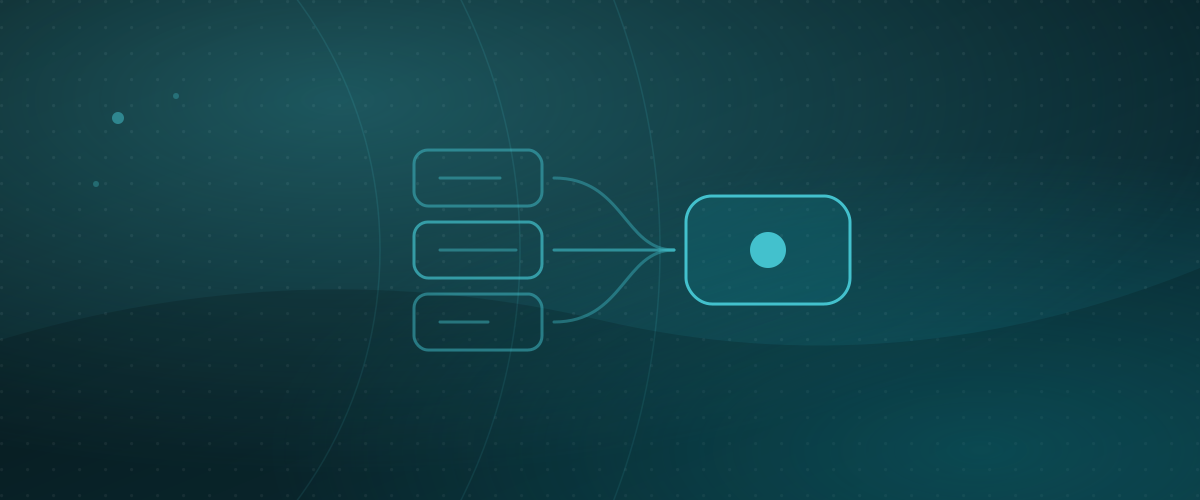
Hand off when the agent's confidence in a grounded answer drops, and carry the whole conversation across when you do. Escalating too early wastes the bot; escalating too late wastes the customer. Retrieval confidence is the trigger worth building on, with a permanently visible talk-to-a-person button alongside it.
Hand off when the bot's confidence in a grounded answer drops, and carry the whole conversation across when you do. Escalating too early wastes the bot; escalating too late wastes the customer. The line between the two is a threshold you tune, not a guess you hope about.
The worst chatbot experience isn't a bot that says "I don't know." It's a bot that pretends to know - or one that traps you in a loop with no way out. The difference between AI support that customers tolerate and AI support they actually like comes down to one design decision: how the handoff to a human works.
The two failure modes
Escalate too little and the bot bluffs - confidently wrong answers, customers arguing with a machine, trust destroyed. Escalate too much and you've built an expensive FAQ page that forwards everything to you anyway. Both failures come from treating escalation as an afterthought instead of a feature.
Escalate on confidence, not keywords
Keyword triggers ("refund" → human) are crude: they escalate questions the bot could answer perfectly and miss novel problems entirely. The better signal is retrieval confidence. When the customer's question matches your documents well, answer with a citation. When nothing in the knowledge base fits, that low confidence is the escalation trigger - the bot knows it doesn't know.
Alongside the automatic trigger, always keep a visible "Talk to a person" button. Forcing customers to defeat the bot before reaching a human is how you end up in screenshots on social media.
A good escalation says: 'I don't want to guess about this - let me get the owner, here's everything so far.'
Four ways tools decide to hand off
Every support bot has an escalation rule somewhere, even if the vendor never mentions it. They come in four families, and the differences show up exactly when a customer is already annoyed.
| Trigger | How it works | Where it fails |
|---|---|---|
| Keyword list | Escalates on words like refund or complaint | Misses everything phrased politely, fires on false alarms |
| Customer asks | A visible talk-to-a-person button | Necessary, but only catches the ones who ask |
| Retrieval confidence | Escalates when no passage matches well | Needs tuning - too strict and it gives up early |
| Sentiment guess | Escalates on frustration signals | Guesswork by another name; angry is not the same as unanswerable |
The confidence threshold is the one worth building on, with the button alongside it as a guarantee. It is the only trigger tied to the actual question: does the knowledge base contain this answer or not? That is also why it degrades gracefully - a badly tuned threshold escalates too often, which is annoying, rather than answering wrongly, which is fatal.
What the handover must carry
The escalation itself is a solved problem. What separates a handover customers accept from one they resent is what travels with it.
- The customer's name and contact, collected once, politely - which is also how a support conversation becomes a lead
- The question exactly as they asked it - not a category code
- The full transcript, including what the bot already said
- Which documents the bot searched, so you know what it ruled out
The unforgivable version is the one everyone has lived: explain the problem to the bot, get transferred, explain it again to a person. Carrying context is the entire courtesy, and it is the thing a shared inbox structurally cannot do. That is how the escalation inbox is built - the email you receive contains the whole exchange, so your first reply picks up mid-conversation instead of starting over.
The two sentences that make or break the handoff
What the bot says at the moment of escalation matters more than any other line you will write. It needs exactly two things: an honest admission and a concrete expectation. "I don't have that answer in the knowledge base, so I'm passing you to the team - they reply within one business day." No apology theatre, no pretending it is checking with a colleague, no vague we'll get back to you soon.
Then collect the name and contact in one step, not a form of eleven fields. Every extra field is also personal data you now have to protect and delete on request, which the DPDP Act treats as your obligation. Every extra field at this moment costs you a lead - the customer has already been told the bot cannot help, and their patience is spent. Name, contact, done; the transcript carries everything else. If they decline to leave contact details, let them - a forced field produces fake emails, and a customer who declines today often returns tomorrow when the question actually matters to them.
The button is not a failure state
Some vendors treat the talk-to-a-person button as a defeat and bury it three menus deep. That reads as confidence and lands as hostage-taking. A customer who wants a human and cannot find one does not go back to trying the bot - they leave, or they arrive at your inbox already furious.
Keep the button visible from the first message. Counter-intuitively, this makes people use it less: knowing the exit exists is usually enough to try the bot first. The customers who press it immediately were never going to accept an automated answer anyway, and you want them in your inbox, not in your reviews.
Tuning in practice: a fortnight of watching
Do not tune the threshold on day one - you have no data, only nerves. Run the default for two weeks and read the transcripts. The symptoms are unmistakable in both directions.
Over-escalating looks like a human answering questions the documents plainly cover; the fix is usually a thin knowledge base, not the threshold at all. Under-escalating looks worse: long bot exchanges that end with the customer leaving, or answers assembled from barely-relevant passages. Adjust once, then watch another fortnight. Ratcheting the dial daily just destroys your ability to read cause and effect.
One more signal worth reading: where in the conversation escalations happen. Handoffs on the first message usually mean customers arriving with problems no document can solve - damaged orders, payment disputes - which is healthy. Handoffs on the fourth message mean the bot answered three times without resolving anything, and those transcripts will show you whether the documents or the threshold is at fault. Read five of them and the pattern is usually obvious within an evening.
How you know the line is right
Two numbers tell you. The escalation share: if four in five conversations reach a human, the threshold is too tight or the knowledge base is too thin. And the gap list: questions that escalated because no document covered them are instructions for what to write next. Watch both for a fortnight before touching the threshold - the metrics post covers what else is worth counting, and the FAQ covers what escalation looks like on each plan.
The handoff is the product
What makes escalation feel premium is the context transfer. The customer should never repeat themselves. A proper handoff delivers the customer's name and contact, the full transcript, and what the bot already tried - instantly, to your email or inbox. You reply once, with full context, and the customer experiences a team that talks to each other.
Done right, escalations stop being failures. The bot filters out the repetitive 80%, and every conversation that reaches you genuinely deserves you. That's not the bot failing - that's the bot doing triage.
Frequently asked questions
When should a support bot escalate to a human?
When retrieval confidence is low - meaning nothing in your documents matches the question well - and immediately on any complaint, dispute or request for an action only a person can take. A visible talk-to-a-person button should work at any point without the customer having to justify it.
Why are keyword-based escalation triggers a bad idea?
They escalate questions the bot could answer perfectly and miss novel problems entirely. A politely phrased complaint contains none of the trigger words; a routine question about refunds contains all of them.
What must travel with an escalation?
The customer's name and contact collected once, the question exactly as they asked it, the full transcript including what the bot already said, and which documents were searched. Without those, the customer explains themselves twice.
What escalation rate is healthy?
If four in five conversations reach a human, either the threshold is too tight or the knowledge base is too thin - usually the latter. Watch it for a fortnight before adjusting anything, then change one thing and watch another fortnight.