The short answer
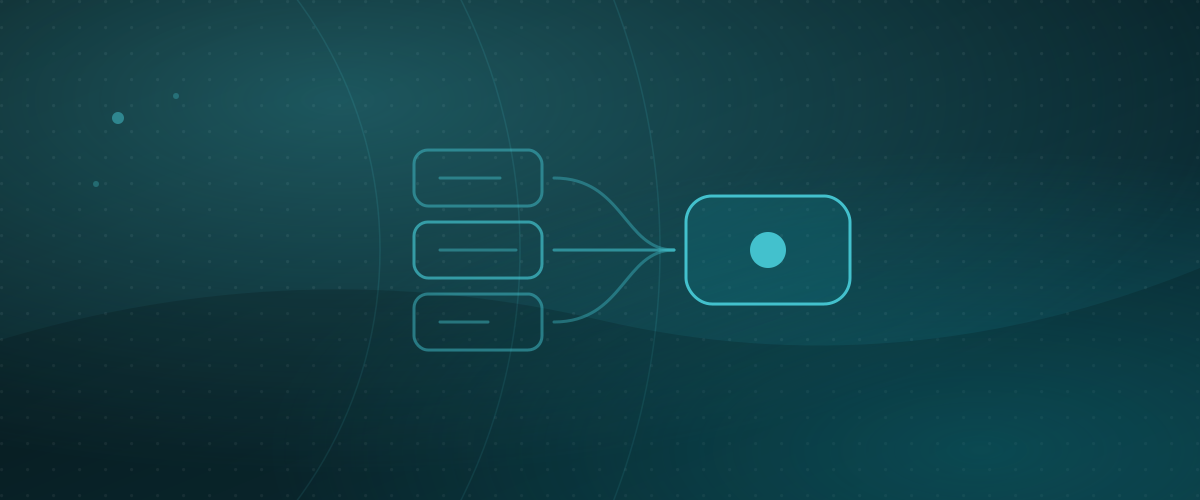
Support answers drift apart because each channel keeps its own copy of the content - a help centre, flow nodes, a script, someone's memory. Consolidating to one knowledge base that every channel reads from turns a policy change from four edits into one, and removes the class of failure where your cheapest channel quotes last year's terms.
Ask your own business the same question three ways this afternoon. Type it into your website chat. Send it to your WhatsApp Business number. Call the number on your contact page. A surprising number of teams get three different answers, and the interesting part is that nobody in the business is wrong. Everyone is reading correctly from a different copy.
Why the copies exist at all
Nobody decides to maintain four versions of the return policy. It happens because each channel was solved separately, in the order the problems appeared.
The website got a help centre, because that was the first channel. WhatsApp got flow nodes, because the WhatsApp tool stores its text inside the builder and there was nowhere else to put it. The phone got whatever the person answering it remembers, which was accurate the day they were trained. And the founder's own replies, sent from a phone at 11pm, are the fourth version - usually the most current one, and the one nobody else can see.
Each of those was a reasonable local decision. Together they are a content architecture where the same fact lives in four places, and facts that live in four places disagree within about a quarter.
Nobody chooses to run four versions of the truth. You just solve four channels on four different Tuesdays.
What it actually costs
The cost is not the duplicated writing - that is an afternoon. It is what happens on the day something changes.
Your return window moves from seven days to ten. You update the website, because the website is visible and someone will notice. You probably remember the help centre. You almost certainly do not open the WhatsApp flow builder, because nothing prompts you to and the node is three screens deep. And you cannot update what the phone answerer remembers except by telling them, which you will do next week.
So the channel your highest-intent customers use is now quoting a policy you changed. When a customer holds you to it, they are holding you to something your own system told them - which is not a defensible position, and is expensive to resolve one customer at a time.
| Where the answer lives | Who updates it | How stale does it get |
|---|---|---|
| Website help centre | Whoever owns the site | Weeks - it is visible |
| WhatsApp flow nodes | Whoever built the flow | Quarters - nothing prompts a review |
| What the phone answerer knows | Nobody, formally | Until the next conversation about it |
| The founder's own replies | Always current | Never - and never shared |
| One knowledge base | Edited once, read by every channel | As current as the last edit |
The single-source version
The alternative is boring in the best way. You upload the documents once - shipping policy, returns, price list, FAQ, store details. Every channel retrieves from those same documents: the website widget, the WhatsApp agent, and the voice agent answering inbound calls.
A customer asking on WhatsApp gets the passage from returns.pdf. The same question typed on your product page gets the same passage, cited to the same file. A caller gets it spoken. When the window changes, you edit returns.pdf, and all three channels change at the same moment because there was only ever one copy.
This is not primarily a convenience feature. It removes an entire class of failure - the class where your business contradicts itself and the customer is the one who finds out.
What legitimately differs per channel
Consistency of facts is not sameness of delivery, and it would be a bad product that ignored the medium.
- Length. A spoken answer is shorter than a chat reply; nobody wants a paragraph read at them.
- Citations. Chat shows the source file inline. Voice does not read out a filename - it says which policy it is quoting.
- Register. The reply mirrors how the customer wrote, so a Hinglish question comes back in Hinglish - the language post covers why that matters more than it sounds.
- Escalation route. Chat hands off to your inbox with a transcript; a call transfers or takes a callback number.
What never differs is the fact underneath. Seven days is seven days on every channel, and it is checkable against the same document on every channel.
The maintenance habit this enables
Consolidation makes a monthly review possible, which is the real win. Twenty minutes, once a month: reread the two documents with numbers in them, delete anything about an offer that has ended, and scan the knowledge-gap list for questions that came back empty.
That is a task a small team can actually sustain, because it is one list and one folder. The four-copy version requires you to remember four places, which is why nobody does it and why the flow builder is always the one holding last Diwali's terms.
How to structure those documents so retrieval finds the right passage is in the knowledge-base guide. Which five to write first is in the e-commerce walkthrough, and the channel pages cover what each one adds on top.
Frequently asked questions
Why do answers differ between my website and WhatsApp?
Because they are usually different content stores. The website reads a help centre; WhatsApp reads text typed into flow nodes. When a policy changes, one gets updated and the other does not - and it is almost always the flow that goes stale.
Do I need separate documents for each channel?
No. The same uploaded documents answer on the website widget, the WhatsApp agent and inbound calls. What changes per channel is length and format, not the facts.
What happens when I update a document?
Every channel reflects the change as soon as it is re-indexed, because they all retrieve from the same source. There is no per-channel republish step.
Does the agent answer differently on voice than in chat?
The facts are identical and cited from the same file. Phrasing adapts to the medium - a spoken answer is shorter and does not read out a filename - but nothing about the underlying policy differs.